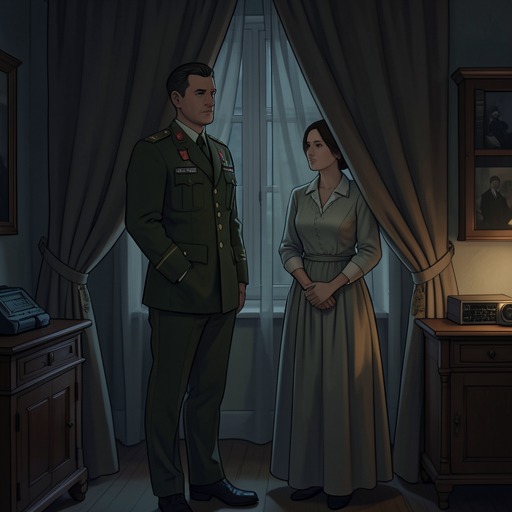
Andrei Tientietnikov–General Betrishev relationship
Dead SoulsThe relationship between Andrei Ivanovich Tientietnikov and General Alexander Dmitrievich Betrishev begins in an apparently minor social slight and grows into a serious estrangement through Tientietnikov’s wounded sense of dignity. The break is not founded on a grave deed: it arises from a chance word, sharpened by the General’s tone and standing as a proud officer. Paul Ivanovitch Chichikov’s attempt to repair the breach exposes both its disproportion and its emotional reality, while the General’s response suggests that reconciliation remains possible.
Background and the Break
Before the disagreement is explained, Chichikov learns from Tientietnikov’s servants that their master used to visit a neighboring General, who had a daughter, and that Tientietnikov and the young woman had once been involved before separating. The account establishes a prior connection between the household and the General’s circle, but the relationship under discussion is ultimately defined by the quarrel rather than by that earlier attachment. Tientietnikov’s repeated drawings of heads that all resemble one another offer Chichikov another clue to his host’s absorbed, inward habits.
When Chichikov cautiously raises what Tientietnikov lacks, the young landowner answers that success depends on having been born under a lucky star, then recounts the history of his acquaintance and rupture with the General. The narrator makes clear that the offense began with a chance remark. Tientietnikov himself distinguishes the remark’s literal content from its force: the insult, he insists, lay in the General’s tone. A kindly and peaceable man, he nevertheless speaks with flashing eyes and a voice vibrating with hurt, making visible how deeply he has taken the slight.
Pride, Rank, and Estrangement
Chichikov tests whether the quarrel required a permanent break. He asks what there was to take offense at and whether Tientietnikov could not have continued visiting the General; in his view, no great harm had been done. Tientietnikov rejects this as a failure to understand the social meaning of the encounter. Had the speaker been an old man in a humble station, he says, the words would have mattered less. Spoken by a proud, swaggering officer, they were something he could not and would not brook.
The contrast exposes the mechanism of the estrangement: the spoken words are described as slight, but rank and tone transform them into an affront to Tientietnikov’s dignity. His refusal to resume the visits is therefore both a personal response and a judgment about how an officer may treat someone of lesser standing. Chichikov privately finds Tientietnikov curious, while Tientietnikov forms the same judgment of Chichikov. Their reciprocal puzzlement keeps the disagreement from being reduced to a simple moral verdict: each man’s certainty about the other is part of the scene’s comedy.
Chichikov’s Attempt at Reconciliation
Rather than continuing to argue with Tientietnikov, Chichikov announces that he will visit the General the next day. The plan surprises and disquiets his host, who asks what purpose such a call could serve. Chichikov says that he will offer an assurance of personal respect, then carries that conciliatory purpose into the General’s presence. He presents Tientietnikov as regretting that he had once failed to show proper respect for the public services the General had rendered.
Chichikov makes the apology more specific by reporting Tientietnikov as wishing he had valued the men who saved their fatherland at their true worth. This is a calculated appeal to the General’s public identity and sense of service, not merely a private request to forget the quarrel. The General’s frown gives way to a softened response: he says he bears Tientietnikov no grudge, has always felt sincere liking and esteem for him, and believes he may in time become a useful member of society. The stated respect is therefore not one-sided; beneath the rupture, the General’s regard for his former visitor has endured.
Meaning and Prospects
The scene closes not with a completed reunion but with the grounds for one. Chichikov endorses the General’s judgment and praises Tientietnikov as a man of worth, eloquent and a master of the pen. The General answers that Tientietnikov writes what he calls rubbish, perhaps verses, preserving a teasing, socially assured manner even as he acknowledges the young man’s promise. His reply neither cancels the earlier injury nor confirms that the two men have met again; it shows instead that the breach need not amount to settled hatred.
The episode’s comic tension lies in the distance between a chance word and the lasting consequence Tientietnikov attaches to its tone, while its sympathy lies in taking that injury seriously rather than dismissing him as merely foolish. This balance accords with the novel’s broader combination of satire and tolerance: characters may be ridiculous without being treated as beyond understanding. Chichikov’s mediation turns the quarrel from a closed grievance into a possibility of renewed contact, and reveals that respect—once spoken aloud by the right intermediary—can survive beneath offended pride.